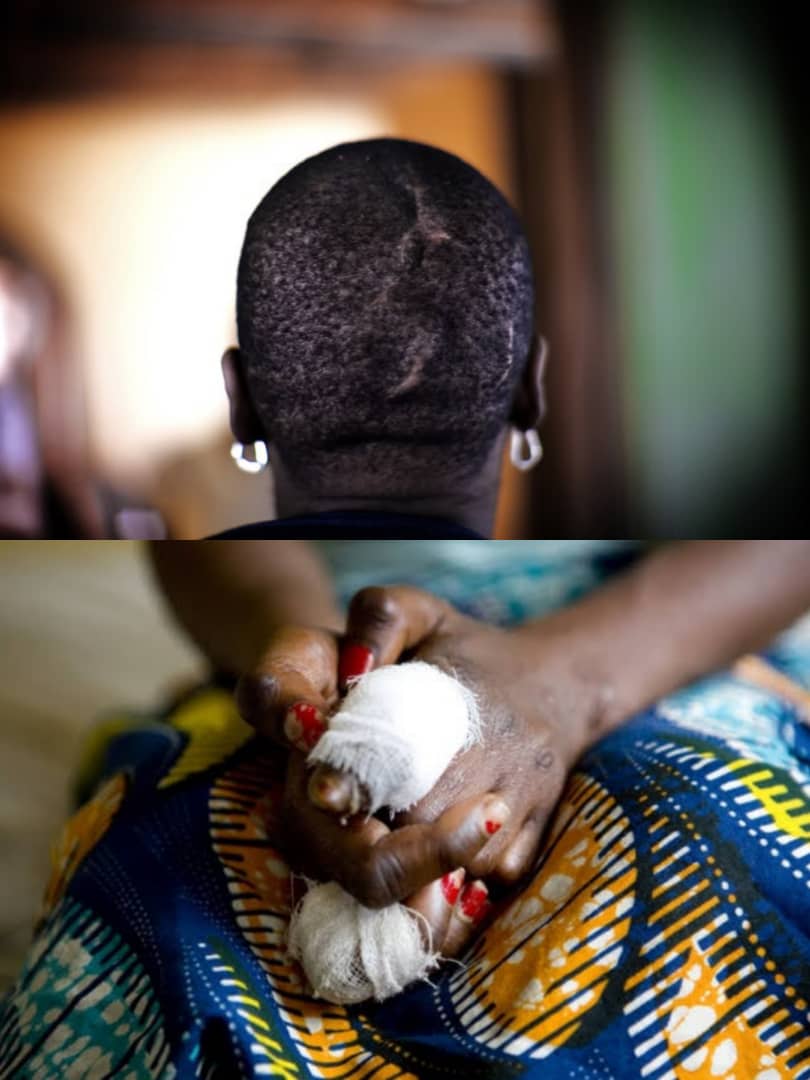
By Mavis Opara
It was a quiet night outside my compound in Aboh Mbaise when the silence broke. A woman came running through the gate in darkness, naked, screaming, bruised, and bleeding, tears streaking her face. Moments later, her husband appeared, climbing over the fence, still trying to land blows even as she fled toward the safety of strangers.
I would later come to know her as “Blessing” not her real name, a name I use to protect her, because she still lives with the man who did this to her, and speaking out comes with real risk.
Her story is not rare. It is one version of a pattern so common in Nigerian homes that it rarely makes headlines. According to the 2024 Nigeria Demographic and Health Survey, 23% of Nigerian women aged 15–49 have experienced physical or sexual violence from a current or former intimate partner. In 2024 alone, Nigeria recorded 135 femicide incidents 149 women killed, many by the very partners meant to protect them.
So why do women like Blessing stay?
Blessing has been married for five years and has four children. She told me that before marriage, her husband was gentle and attentive but the moment they married, something changed.
“The first time he beat me was when I was eight months pregnant,” she said. “That day he asked me for sex. I told him I was heavily pregnant and my hormones were dealing with me. He asked me if I was giving birth to Jesus Christ. I said no, it is Virgin Mary. Then he beat me with his belt and pushed me down the stairs.”
Despite years of abuse, Blessing has not left. “I am tired of the marriage,” she said, “but I endure because of my children. If I leave, I will become a single mother, and I don’t have the capacity to take care of them.” She said that if she became financially independent, she would leave immediately a sentiment she believes many women around her quietly share. “If most women are made to start making their own money,” she said, “many women I know will leave their marriages.”
She also pointed to the weight of family and social pressure. Her own brother urged her not to leave. And beyond family, she fears the judgment of her community the risk of being labeled, as she put it, a woman of “bad character” simply for leaving.
Blessing said her brother in-law wife died as a result of domestic violence a reminder, she said, of how far this pattern can go when it is left unaddressed.
The night I first encountered Blessing, she wasn’t feeling well. She had taken medication and told her husband she wasn’t in a state for sex. He didn’t accept that answer.
“He started beating me,” she said. “Neighbors tried to intervene, but he attacked them too. He tore my clothes and held my neck until I could barely breathe. I managed to escape his grip and ran out of the house naked to the next compound, where the neighbors saved me. But he jumped over the fence into that compound to come after me.”
That compound was mine. I watched it happen in real time a woman fleeing for her life, and a man climbing a fence to continue an assault in full view of strangers.
Blessing did not report the incident to the police. She said she couldn’t afford the costs that often come with pursuing a case, and that in her community, matters like this are typically resolved within families rather than through formal law enforcement.
If Blessing’s story shows how children can bind a woman to abuse, Mary’s shows how faith, silence, and fear of judgment can do the same different reasons, the same outcome: staying, enduring, surviving in silence.
Their stories are not unusual. They are two versions of what millions of Nigerian women quietly live through women who wake up each day beside the person most likely to hurt them, and who see no path out that feels safer than the one they’re already on. For some, that path is blocked by money. For others, by faith, family pressure, or a community quick to blame the woman who leaves rather than the man who hurts her. For some women, the abusive home is not just a marriage it is the only family structure they have ever known, the only one they believe will take them back if everything else falls apart.
Mary also not her real name was married to a pastor whose abuse began almost immediately. “My marriage started having issues three weeks after my wedding,” she said. Even before the wedding, her brother had noticed warning signs. On the day the pastor came to pay her bride price, her brother pulled her aside and warned her about something he’d seen in the man’s character.
Unlike Blessing, Mary said the violence often came without any clear provocation. “The first time he beat me was when I was pregnant with my first child,” she said. “I mistakenly spilled water on the floor, and he beat me for it.” Another time, she said, he beat her simply for answering a neighbor’s question about his own wife’s whereabouts. “My crime was that I responded,” she said.
The threats were constant. “He threatened several times to kill me,” she said. Looking back now, she believes those threats were not empty. “If he were still alive and we were still together, he would have killed me.”
Despite the abuse, Mary said leaving was never a real option for her at the time. Her religious beliefs forbade divorce. She feared the judgment of her community and the names she would be called. Her own family, she said, would accuse her of not enduring enough. Through it all, she held on to a quiet hope: “I thought he would change.”
The pastor has since died. Mary is now a single mother raising her one child alone and has chosen not to remarry.
In 2022, Nigerian gospel singer Osinachi Nwachukwu died after years of alleged abuse by her husband, Peter Nwachukwu, a pastor and gospel minister. Her death was initially said to have died of throat cancer, before her family went public with allegations of domestic violence. A judge later convicted her husband on 23 charges, including culpable homicide, and gave him the maximum sentence for the crime. The court found that the prosecution had proven the case, with testimony from 17 witnesses, including two of the couple’s own children.
https://www.bbc.com/news/articles/c705yg0rdego
What Mary, Blessing, and Osinachi’s stories all reveal is a pattern more disturbing than silence alone: women enduring abuse even after being explicitly told their lives were at risk. Mary herself said her husband threatened to kill her not once, but several times. Blessing continued to live under the same roof as a man who had already strangled her to the point of near-unconsciousness. This is perhaps the most difficult truth in domestic violence: many women do not stay because they don’t believe the threat. They stay knowing it is real, and still find themselves unable to leave.
Blessing and Mary’s stories are only two among an untold number that never reach a headline, a courtroom, or even a neighbor’s ear. Many women suffer in silence far more severe than either of theirs some enduring the same beatings for decades without a single documented case, some like Blessing’s co-wife, dying long before their stories are ever told. For every case that becomes news, an unknown number remain buried in silence, in shame, or in fear.
This is not a uniquely African problem domestic violence exists everywhere. But what often separates a woman’s ability to survive it from her ability to escape it is infrastructure: functioning shelters, accessible legal aid, police who take reports seriously, and a justice system that moves before more damage is done. In much of Nigeria, that infrastructure remains thin. The Violence Against Persons (Prohibition) Act of 2015, and Imo State’s own VAPP Law of 2021, exist on paper but as both Blessing and Mary’s experiences show, most women never even attempt to use them, because the system to enforce them feels distant, expensive, or indifferent.
Until that changes until reporting a beating doesn’t cost more than staying silent, until leaving doesn’t mean losing everything women like Blessing and Mary will keep calculating, every day, whether survival means staying or whether staying is what will eventually kill them.
That night outside my compound, Blessing survived. Not every woman does.
( I do not claim ownership of the image.
Image source:google )
