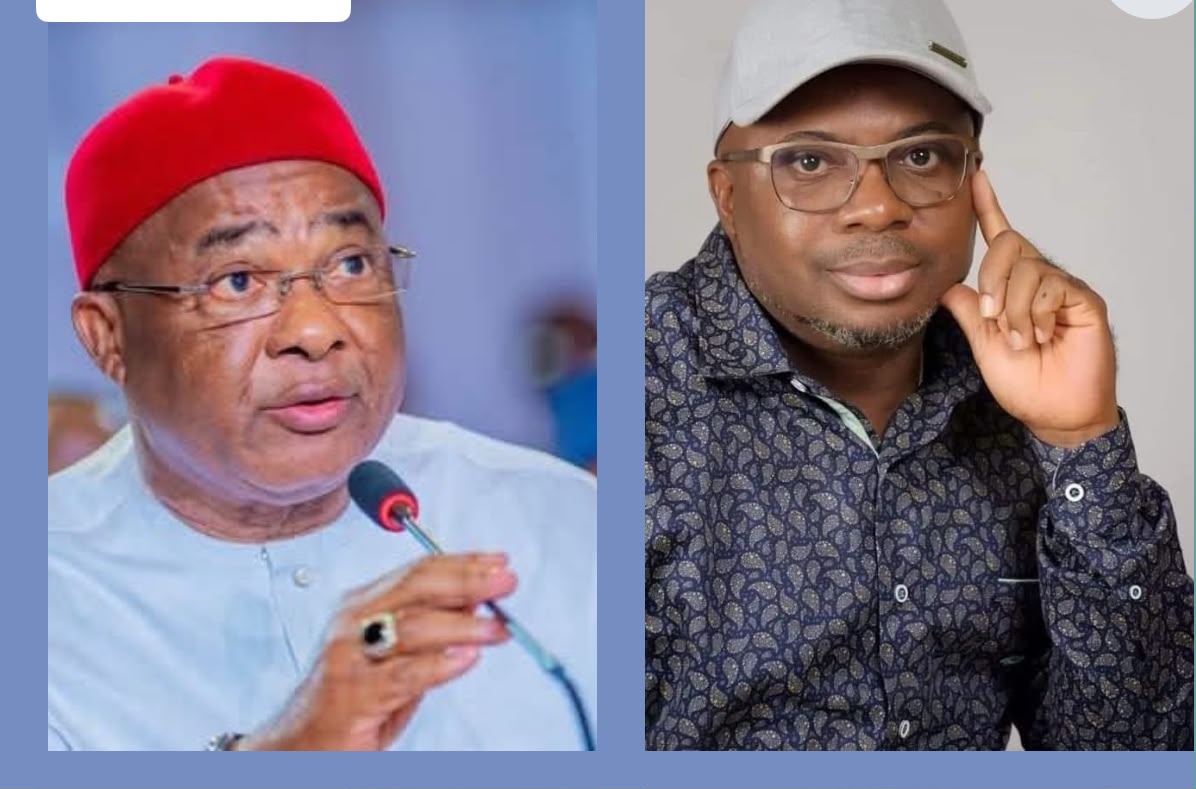
By Fred Iwuagwu
Former member of the House of Representatives and Imo State Commissioner for Housing, Rt. Hon. Bede Eke, has said Governor Hope Uzodimma has placed Imo State on the global map through a combination of infrastructure development, economic initiatives and strategic investments across key sectors. Eke, in a strongly worded article titled “Gov Uzodimma Has Put Imo on the World Map, Local Politics Cannot Erase It,” said the transformation in the state had become too visible to be erased by partisan politics. He cited the recent remarks by Nigeria’s First Lady, Senator Oluremi Tinubu, who, after visiting the state, said: “I want to commend the Governor. I don’t flatter. He has brought the world to Imo. Imo is bubbling. The transformation I have met on ground, I am pleased.”
According to Eke, the First Lady’s assessment was significant because it came after she had personally seen some of the infrastructure and development projects in the state. He argued that her remarks were “not campaign slogans manufactured in Owerri” but the observation of “a national figure after seeing Imo for herself.” Eke listed the 56 kilometre Okigwe–Owerri Road, 36 kilometre Owerri–Obowo–Umuahia Road, dualised Owerri–Orlu Road, Orlu–Umuchima–Akokwa Road, MCC–Toronto–Uratta corridor and Chukwuma Nwoha Road among major projects that, he said, had changed the physical and economic landscape of the state. He also cited the Assumpta Flyover, urban renewal in Owerri and upgrades at Sam Mbakwe International Cargo Airport, including night landing capability.
The former federal lawmaker said the administration’s achievements went beyond road construction, pointing to the Emmanuel Iwuanyanwu International Conference Centre, the restored Concorde Hilton Hotel and the Imo Digital City. He said these projects had created physical and economic assets capable of attracting international business, tourism and technology opportunities to the state. According to him, “These are physical assets that now form part of the state’s development landscape.” He also noted that more than 120 roads had been completed across Imo, including 37 new roads within an 18 month period.
Eke described the energy sector as another important component of the administration’s development strategy, particularly the ANOH Gas Processing Plant and the Orashi energy projects. He said the significance of the gas project extended beyond infrastructure, arguing that gas remained critical to industrialisation, power generation and job creation. “Roads alone cannot create an industrial economy. Electricity infrastructure is key,” he stated, adding that the administration’s plans around the Orashi Energy Free Trade Zone, industries, agriculture and the Orashi corridor reflected a broader ambition to move Imo from a predominantly consumer economy to a “serious production, logistics, energy and investment hub.”
The commissioner also highlighted interventions in healthcare, education, agriculture, women empowerment and human capital development. He cited the rehabilitation of primary healthcare centres, development of modern general hospitals, interventions in tertiary institutions, digital skills programmes and the Skill-Up Imo Project as part of what he described as an interconnected development agenda. Eke said the recent empowerment programme involving 2,500 women and vulnerable persons further demonstrated the collaboration between the federal and state governments, noting that the state contributed an additional 2,000 empowerment items while the First Lady announced ₦100,000 for each beneficiary.
On the political implications of the development, Eke accused some opposition politicians of allowing partisan interests to overshadow the state’s progress. He said opposition was legitimate when it interrogated government and offered alternatives, but warned that “when opposition becomes an exercise in denying visible development and attacking everything that carries the name of the Governor, it ceases to be credible.” He also rejected attempts by individual political aspirants to claim the exclusive right to speak for Ngor Okpala, insisting that the people of the area had their own leaders, judgment and understanding of the state’s political direction.
“I have no doubt at all that some of the roads in Ngor Okpala that require attention will certainly be fixed before long. I can assure that 100 percent of our votes in Ngor Okpala will be cast for the APC at levels next year. This is the Ngor Okpala consensus,” he insisted.
Eke concluded that the enduring test of governance should be what remains on the ground after political arguments have ended. “A road either exists or it does not. A flyover either reduces congestion or it does not. An international conference centre either attracts events or it does not. An airport either operates at night or it does not,” he said. He urged Imo people to judge the Uzodimma administration by the record before them and aspiring politicians by the substance of the alternatives they offer, stressing that “Imo has moved from being discussed only within the narrow confines of local politics to attracting national attention.”
