By Our Correspondent
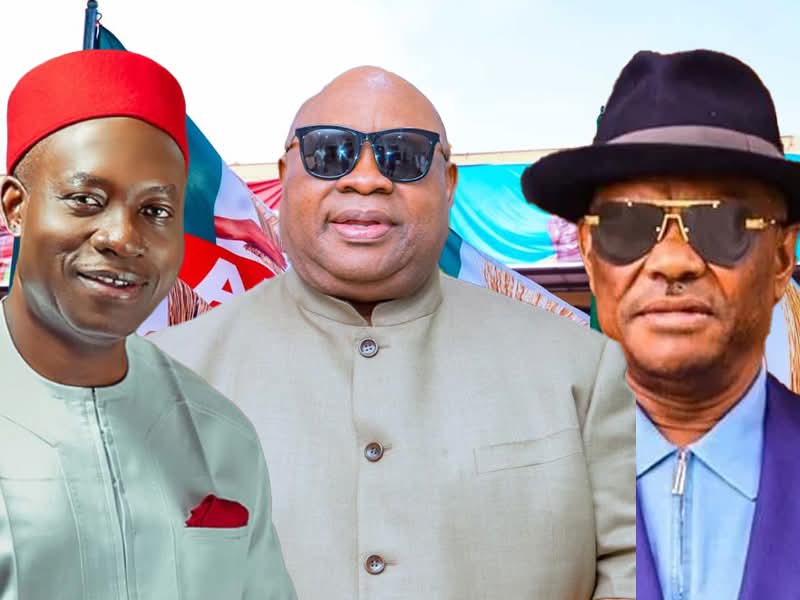
Nigeria’s political landscape is attracting renewed attention following reports that President Bola Tinubu’s All Progressives Congress (APC) Presidential Campaign Council has been expanded and restructured to accommodate prominent political figures, including Nyesom Wike, Chukwuma Charles Soludo and Ademola Adeleke.
The development has generated interest across the country, particularly as political parties, governors and influential stakeholders begin positioning themselves ahead of the 2027 general elections.
The reported inclusion of the three politicians has added a new dimension to discussions surrounding political alliances, campaign coordination and the evolving relationships between the ruling APC and influential figures associated with other political parties.
Among the prominent names reportedly included in the revised campaign structure are Nyesom Wike, Minister of the Federal Capital Territory; Chukwuma Charles Soludo, Governor of Anambra State; and Ademola Adeleke, Governor of Osun State.
Their reported inclusion has attracted attention because the three politicians have different political backgrounds and operate in separate regional political environments.
Wike is a prominent figure associated with the Peoples Democratic Party (PDP), while Soludo is a member of the All Progressives Grand Alliance (APGA). Adeleke has been associated with the PDP and, more recently, the Accord Party.
Their reported roles in the campaign council have raised questions about possible cooperation among political figures from different parties ahead of the next presidential election.
However, participation in a campaign structure should not automatically be interpreted as a formal change of party membership.
Wike’s reported inclusion has drawn attention given his influence in Rivers State politics and his current position as Minister of the Federal Capital Territory.
The former Rivers State governor remains an important figure in discussions about political alignments in the South-South region. His relationships with political stakeholders in Rivers and beyond have frequently placed him at the centre of national political debates.
His reported assignment involving Rivers State and the FCT could bring renewed focus to political activities in these territories as preparations for the 2027 elections continue.
The development also highlights the role of state-level political networks in presidential campaigns, where local organisation, stakeholder engagement and voter mobilisation can shape campaign activities.
Soludo’s reported appearance on the revised list has also attracted attention, particularly because of his position as governor of Anambra State and his affiliation with APGA.
The South-East remains an important part of Nigeria’s political landscape, with party loyalties, regional interests and relationships between federal and state governments featuring prominently in political discussions.
Soludo’s reported role in the APC presidential campaign structure could become a subject of further debate as political actors assess the nature and extent of cooperation across party lines.
Nevertheless, the reported appointment does not, on its own, indicate that Soludo has left APGA or formally joined the APC.
In Osun State, Adeleke’s reported inclusion has added another talking point to the political conversation ahead of 2027.
As the state’s governor, Adeleke occupies a prominent position in South-West politics. His reported designation as a coordinator for the presidential campaign in Osun has raised questions about how the revised council intends to organise its activities across different states.
The development has attracted attention given the competition among political parties in the South-West, a region that remains central to national electoral calculations.
Any confirmed collaboration involving Adeleke and the APC campaign structure would be closely watched for what it reveals about political relationships and cooperation in the state.
For now, the reported appointment should be distinguished from any claim of formal defection or a confirmed change in party allegiance.
The reported restructuring comes as political stakeholders increasingly turn their attention to the 2027 general elections.
Presidential campaigns typically require extensive coordination across states, involving party officials, elected representatives, community leaders and other influential political figures.
An expanded campaign council can provide a framework for coordinating activities across different regions and engaging stakeholders with varying political interests.
The reported inclusion of figures with different party backgrounds has also brought renewed attention to the role of political alliances in Nigeria’s electoral process.
However, the practical implications of the revised structure will depend on the final membership list, the responsibilities assigned to individual coordinators and the extent to which the reported arrangements are formally confirmed.
The development comes amid continuing political negotiations and changing relationships among Nigeria’s major political actors.
As the next general elections approach, politicians and parties are expected to consider a range of issues, including state interests, party structures, policy priorities and relationships with influential stakeholders.
The reported appointments of Wike, Soludo and Adeleke have consequently become part of a wider conversation about how political cooperation may evolve in the months leading up to the election.
Such developments do not necessarily mean that existing party structures will disappear. Rather, they highlight the difference between formal party membership, political cooperation and participation in campaign activities.
Whether the reported arrangements translate into a broader political alliance remains to be seen.
President Tinubu’s reported expanded campaign council is expected to attract further attention as details of its membership, leadership and operational responsibilities become clearer.
Political observers will be watching for official confirmation of the appointments and any additional changes to the campaign structure.
The level of coordination among the council’s members, as well as their respective roles in state-level mobilisation, will also be important in understanding how the campaign organisation develops.
For the APC, attention will focus on clarifying the structure and responsibilities of the expanded council. For other political parties, the development may prompt further discussion about their relationships with influential figures linked to the campaign.
With the 2027 general elections approaching, the reported inclusion of Wike, Soludo and Adeleke in Tinubu’s expanded presidential campaign council has added another layer to Nigeria’s evolving political landscape.
The development brings together three prominent politicians with different party backgrounds and regional bases, making the reported appointments a subject of public and political interest.
As more details emerge, attention will remain on the official status of the appointments, the precise responsibilities assigned to the three figures and whether the reported arrangements signal a broader pattern of cross-party cooperation.
For now, the development has brought campaign organisation, political relationships and strategic positioning into sharper focus as Nigeria moves closer to the 2027 electoral cycle.
