By Opara Ejike
In a decisive move to transform the education sector in Abia State, Governor Alex Chioma Otti has signed into law a comprehensive Educational Reform Bill. The new legislation introduces several bold measures aimed at curbing financial exploitation in schools, improving academic standards, and making education more affordable for families across the state.
The reforms apply to all schools in Abia State, both public and private, and take immediate effect.
One of the major provisions of the new law is the regulation of the cost of school leaving certificates. All schools are now required to issue certificates to graduating students at a fixed fee of 2,000 Naira. This move is intended to eliminate arbitrary and excessive charges previously imposed by many institutions, especially private schools.
Another critical provision is the ban on student transfers in Senior Secondary School 2 (SS2). Under the new policy, students must complete both SS2 and SS3 in the same school, which will also serve as their designated center for WAEC and NECO examinations. This reform is aimed at discouraging last-minute transfers often associated with attempts to register at so-called “miracle centers” where exam malpractice is more prevalent.
To ensure academic readiness and uphold examination integrity, the bill introduces a Government Centralized Examination (GCE), which every student must pass before being eligible to register for WAEC or NECO. This standardized state-level exam will serve as a benchmark for determining students’ preparedness for national examinations.
Also included in the reforms is a directive that textbooks must be reused from year to year. Students will no longer be allowed to write inside their textbooks, particularly when completing assignments or homework. This policy is intended to reduce the financial burden on families, allowing younger siblings to use the same books and eliminating the need to buy new ones each term.
The bill also addresses the growing trend of extravagant graduation ceremonies for nursery and primary school pupils. These ceremonies, often accompanied by costly clothing, party fees, and souvenirs, have been officially banned. Schools are now required to conduct simple and meaningful transition activities that reflect the educational significance of the moment without placing unnecessary financial pressure on parents.
Importantly, these new rules are binding on both public and private schools. The Ministry of Education has been tasked with monitoring compliance and enforcing the new guidelines. Schools found violating any part of the reform may face sanctions or other disciplinary actions.
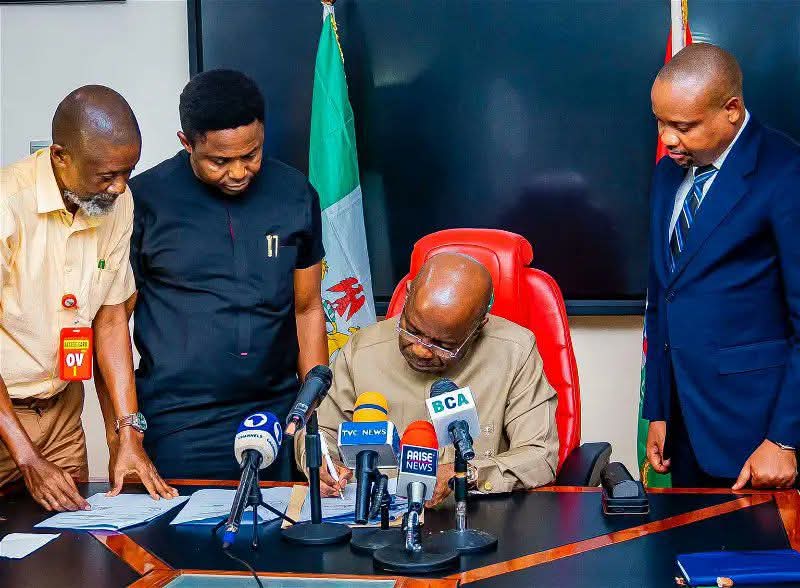
Governor Otti, while signing the bill into law, emphasized the importance of creating an educational system that prioritizes quality, discipline, and fairness. He described the bill as a people-centered reform that puts the interest of parents and students first.
Our mission is to create a system where education is not a burden to families, but a right that is accessible, affordable, and credible for every child, the governor stated during the signing ceremony.
The reforms have been met with widespread approval from parents, education professionals, and civil society organizations who see the measures as a timely intervention to address deep-rooted challenges in the education system.
As Abia State prepares for a new academic session, the focus will now shift to effective implementation, monitoring, and the long-term impact of the reforms on the lives of students and the future of education in the state.
