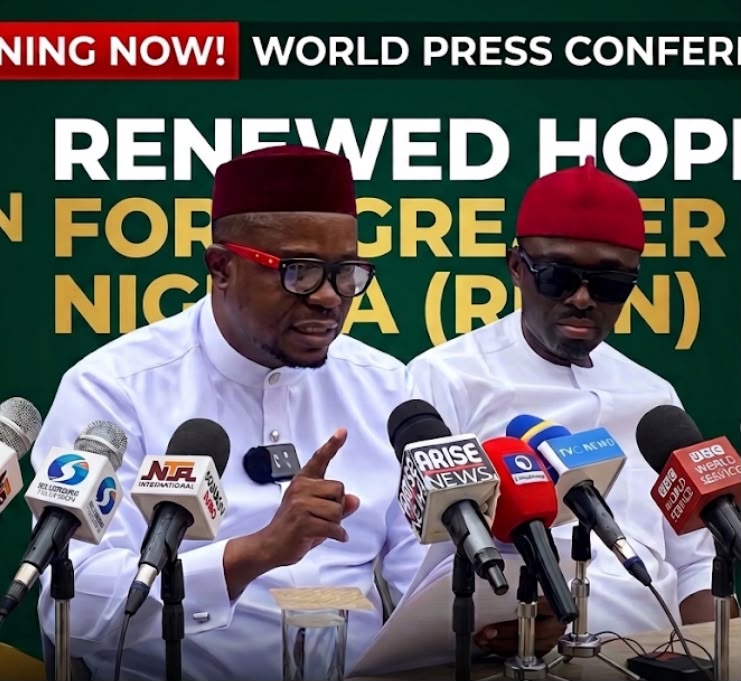
– Vows to give President Tinubu 4 million votes in Southeast
TEXT OF WORLD PRESS CONFERENCE BY THE SOUTHEAST CHAPTER OF RENEWED HOPE FOR GREATER NIGERIA (RHGN) HELD THIS DAY, JULY 9, 2026 IN OWERRI, THE IMO STATE CAPITAL
We thank Almighty God for making this day possible, and we welcome members of the press, our leaders, and our Igbo brothers and sisters gathered here in Owerri. Before we say another word, we must pay homage to the man whose vision brought this movement into being. Two weeks ago in Abuja, our National Leader, Hon. Calistus Anyanwu, stood before this nation and unveiled Renewed Hope for Greater Nigeria as a structure built to defend and advance a simple truth: that President Bola Ahmed Tinubu has earned the trust of every Nigerian who wants this country to work. We salute his courage, his clarity, and his leadership, and we tell him today that the Southeast has heard the call.
We have not come here today merely to speak. We have come to announce a structure, a machinery, and a mission. Renewed Hope for Greater Nigeria in the Southeast is not a press release organization. We are a movement built from the ward up, and we want every Nigerian, every observer, and indeed every skeptic to understand exactly how deliberate and how comprehensive our mobilization architecture is.
We announce today that our state, senatorial district, local government, and ward structures across all five states of the Southeast are already fully formed. This is not a promise for tomorrow. It is a completed foundation upon which everything else we now build will stand. From Ebonyi to Anambra, from Imo to Abia, from Enugu through every ward, our structure is alive, staffed, and ready.
Building on that foundation, we announce that in the coming weeks, RHGN Southeast will inaugurate a 50-man Booth Army at every single polling booth across the Southeast.
This is not a symbolic gesture. It is a serious, disciplined, grassroots deployment whose mandate is twofold: the mobilization of voters for President Tinubu, and the protection of the mandate that Ndigbo will cast on election day. We have seen too many elections in this country where the will of the people was expressed at the polling unit only to be distorted somewhere between the booth and the collation center. That will not happen under our watch in the Southeast. Wherever a vote is cast for this President, our Booth Army will be present to see that it is counted as cast.
We also announce, effective immediately, the creation of Campus Wings across every tertiary institution in the Southeast, from our federal and state universities to our polytechnics and colleges of education. Our youths are not spectators in this project. They are the generation that will inherit whatever we build or fail to build today, and we intend to meet them where they are, on our campuses, with facts, with structure, and with purpose.
Alongside the Campus Wings, we announce the immediate creation of Market Wings in every major market across the Southeast. Our market women and men are the backbone of this zone’s economy and the truest barometer of how policy affects everyday life. They feel subsidy removal first. They feel improved roads first. They feel security or the lack of it first.
We are organizing them not to be spoken for, but to speak for themselves, ward by ward, market by market.
Let us be unambiguous about why we are building this machinery with such urgency and such scale. We have risen in defense of the collective interest of the Igbo. This is not a campaign of convenience or a project of a few elites seeking proximity to power. It is a mobilization rooted in the conviction that the Southeast has, for the first time in a generation, a genuine stake in the direction of this nation, and that stake must be defended with the same seriousness with which it was earned.
It is on this footing, structurally organized from the ward to the polling booth, from the campus to the market square, that we make a public and firm commitment today. We shall certainly deliver four million votes for President Bola Ahmed Tinubu in the Southeast come 2027. This is not a boast. It is a target set by leaders who know precisely what structure they command and precisely what our people believe.
We are here in Owerri not to make noise, but to make a case, the kind of case that is built not on sentiment but on record. For too long in this country, political loyalty has been demanded of the Igbo without evidence being offered in return. We reject that pattern today. Everything we say to you this morning can be checked, verified, and seen with your own eyes across the five states of our zone.
Let us begin with a wound that has festered for decades. Every geopolitical zone in this federation has at least six states. The Northwest, the largest bloc, has seven. The Southeast, despite our population, our productivity, and our contribution to this nation’s commerce and intellect, has been left with five. This is not a technicality. It is a structural injustice that has cost us federal allocations, National Assembly seats, and a proportionate voice in the very institutions that decide our future. No administration before this one moved the needle on this question in any serious way. President Tinubu has. The process toward an additional state for the Southeast is no longer a matter of if, but of when, and that shift alone represents more progress than the previous quarter century combined.
Consider, too, the question of security, a question that for the Igbo is not academic but generational. As far back as the Aburi Accord of 1966, our people understood that a security architecture designed in Lagos or Abuja, with no understanding of our terrain, our language, or our communities, would never truly protect us. State policing was born of that understanding, and it died a slow death in the hands of successive governments too fearful or too indifferent to implement it.
Under President Tinubu, that fear has been replaced with action. State police is now at an advanced stage of implementation nationally, and when it arrives, it will hand our governors, Igbo governors, answerable to Igbo people, the tools to secure Igbo land in ways Abuja never could.
Now let us speak of resources, because no conversation about marginalization in this country is complete without an honest reckoning of who profited and who was left behind. Oil has been drawn from beneath the soil of Imo, Abia, and Anambra for decades, yet the wealth it generated flowed disproportionately to interests far from the communities that bore the ecological and social cost. A subsidy regime that many independent observers have since described as one of the most fraudulent transfer mechanisms in Nigeria’s history quietly enriched a small circle while our states begged for basic funding. President Tinubu ended that regime. It was not a popular decision in the short term, and we do not pretend the transition was painless for ordinary families. But it was the honest decision, and its dividends are now undeniable.
Where our states once received a fraction of what was rightfully theirs from the Federation Account, they now receive substantially more, and that increase is not an abstraction. It is asphalt. It is streetlights. It is hospitals under construction in Owerri, Umuahia, Enugu, Awka, and Abakaliki. Any governor in this zone, regardless of party, will tell you privately that the resource envelope available to them today bears no resemblance to what existed three years ago. We ask journalists in this room to verify this with FAAC disbursement records rather than take our word for it, because the numbers speak louder than any politician can.
Beyond subsidy reform, the faithful implementation of the Petroleum Industry Act has begun to do something no government had managed in a generation. It has started to give oil bearing communities an actual stake in the wealth beneath their feet. Host community trust funds, once a paper promise recycled in every campaign season, are becoming a lived reality. This matters more than it may first appear, because restiveness in our oil communities was never simply about criminality. It was about young men and women watching wealth extracted from their ancestral land while they inherited nothing but pollution and neglect. When you give a people ownership, you take away the raw material of agitation. That is precisely what this administration is doing.
Let us turn to a debt this nation has owed the Southeast since 1970. When the civil war ended, Ndigbo were promised reconstruction and rehabilitation under the banner of reconciliation. For over fifty years, that promise was little more than a phrase recited at ceremonies. Roads remained broken. Industries that once made the Southeast the industrial heartland of this nation were allowed to die. An entire generation grew up watching their region fall behind while being told to be patient. That patience has now been rewarded. The South East Development Commission exists today, it is funded, and it stands as the first serious federal instrument dedicated exclusively to rebuilding what the war and the decades of neglect that followed took from us.
We do not ask anyone in this room to romanticize the recent past. We ask you to remember it honestly. Before this administration intensified security collaboration with our governors, the Southeast was a region under siege from within. Killings. Arson. Kidnappings. A collapse of law and order driven by secessionist agitation that turned our markets into ghost towns and our highways into corridors of fear. Businessmen relocated. Investors fled. Every Monday, our own people were made prisoners in their own homes by sit-at-home orders enforced through terror. This was the Southeast that existed. We must never allow anyone to rewrite that history for political convenience.
Today, that grip has loosened considerably. Markets that once shut their gates in fear now open through the week. The sit-at-home orders that paralyzed our economy have lost much of their power over our people. This did not happen by accident, and it did not happen because agitators grew tired. It happened because this administration made a deliberate choice to work with our governors, reinforce our security agencies, and restore the authority of the state in Igboland. Peace is not yet perfect, and we will not insult your intelligence by claiming otherwise. But the trajectory is unmistakable, and it points toward recovery.
Infrastructure, too, tells a story that numbers alone cannot capture. The Enugu—Makurdi road, our zone’s vital link to the North and a route abandoned for years, is now under active construction. The Enugu—Onitsha Expressway, left to decay through multiple administrations while our people risked their lives daily on its craters, is being rebuilt. The Enugu—Umuahia highway and dozens of other federal roads across our zone are being reborn.
For a people whose identity is inseparable from commerce and enterprise, this is not a minor achievement. It is existential. An Igbo trader without a passable road is a trader without a livelihood. Every kilometer of new asphalt in our zone is, quite literally, wealth returned to our people.
We say all of this not to flatter power, but because it is the truth, and the truth deserves to be spoken plainly in a nation where political loyalty has too often been rewarded with silence rather than results.
It is on this record, not on promises, not on emotion, but on record, that Renewed Hope for Greater Nigeria stakes its claim before Ndigbo today. For generations, our people spoke of an Igbo presidency as though it could only mean an Igbo man occupying Aso Rock. We say to you today that the presidency our ancestors truly longed for was never about the ethnicity of the occupant. It was about a President who would see the Southeast, listen to the Southeast, and act deliberately for the Southeast. By that standard, the only standard that matters, President Bola Ahmed Tinubu has done what many assumed only an Igbo president could do.
We are not naive. We know that hardship remains in many homes across our zone, and we do not stand here today to insult anyone’s daily struggle. Economic reform of the scale this administration undertook was always going to demand sacrifice before it delivered relief. What we ask of our people is not blind faith, but an honest comparison between where the Southeast stood in 2023 and where it stands today.
We therefore call on every son and daughter of Igboland, our traditional rulers, our market women, our professionals, our clergy, our students, and above all our restless and talented youths, to look beyond the sentiments that have too often left us on the margins of power, and to weigh this record with clear eyes as 2027 approaches.
This is not the season to be bystanders in a government that has, in word and in deed, demonstrated that it means well for our people. History will not be kind to a generation of Ndigbo who had the evidence before them and chose silence over strategy.
On behalf of the entire leadership of Renewed Hope for Greater Nigeria, we thank you for honoring this invitation and for the platform this press affords us to speak directly to our people.
Ndigbo, the time to mobilize is now. Let 2027 be remembered as the year our people spoke with one voice, in defense of a government that finally spoke for us. Thank you, and God bless the Southeast. God bless Nigeria.
Signed:
Mazi Franklin Ngoforo
Deputy National Leader (Southeast), Renewed Hope for Greater Nigeria (RHGN)
