By Onyinyechi Nwankwo
Architects in Imo State have been urged to strengthen the visibility of their profession, tackle challenges confronting the industry and become more actively involved in governance and national development.
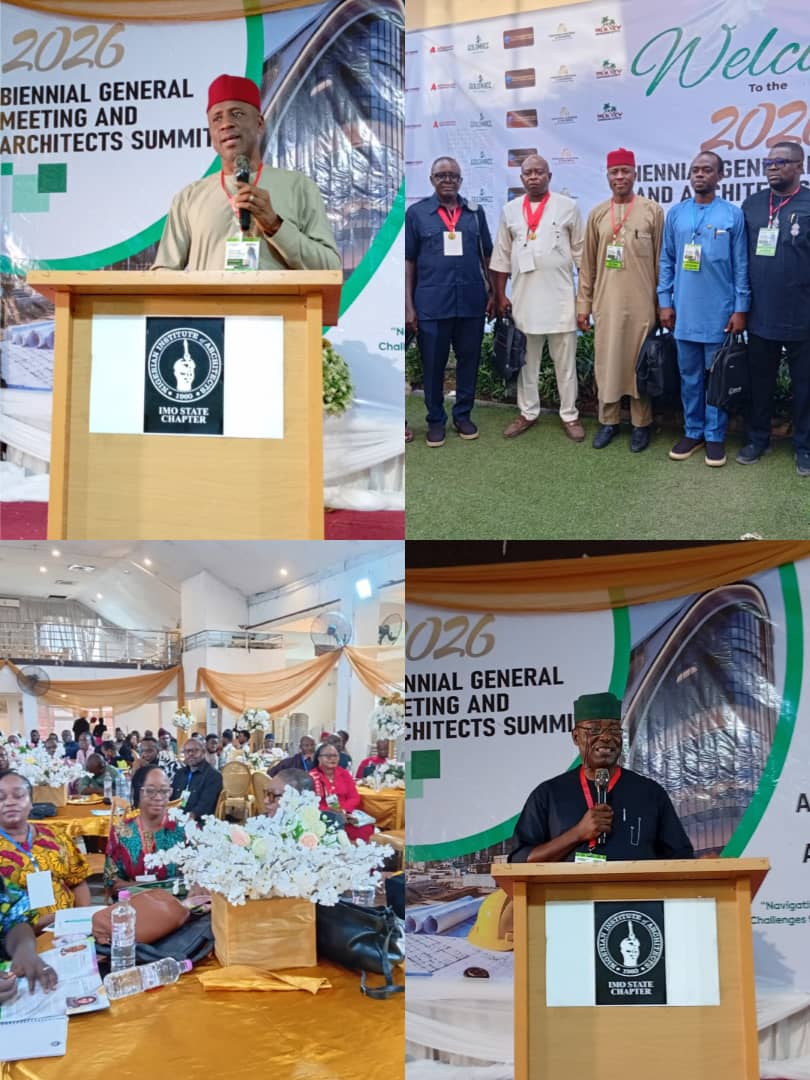
The call was made at the 2026 Biennial General Meeting (BGM) and Architects Summit 6.0 of the Nigerian Institute of Architects (NIA), Imo State Chapter, held on Thursday at Graceland Event Centre, Owerri.
The summit, which was held under the theme, “Architecture Visibility and Practice in Nigeria: Navigating the Political and Socio-economic Challenges Through Innovation, Collaboration and the Social Media Space,”
had the former commissioner for Housing and Urban Development, Arc. Chijeoke Onumajuru, FNIA, as Chairman of the occasion.
Declaring the summit open on behalf of the NIA President, Arc. Itishan Sani Saulawa, FNIA, the National Treasurer, Arc. Moses Nnanna Ajah, commended the Imo Chapter and its leadership for their vibrancy and progress.
Ajah urged members to collectively confront the challenges facing the institute at both state and national levels, stressing that the responsibility for addressing them rested on all architects.
He expressed confidence that their collective efforts would promote the growth and success of architectural practice in Nigeria and strengthen the profession’s contribution to national development.
In his valedictory address, the out going chairman of the Imo Chapter, Arc. Nnaemeka Ozoude, described Imo architects as resilient, enterprising and progressive, noting that the chapter had recorded significant achievements during his tenure.
He disclosed that members had designed a plaza comprising 20 lettable office suites and a secretariat for the chapter, while membership continued to grow, with 14 financial fellows, 31 financial members, 20 financial associates and several financial technologists and graduates.
Ozoude said the chapter’s monthly meetings attracted an average of 50 members, while architecture students in the state continued to benefit from its mentorship programmes. He also highlighted its oversight of architecture schools, particularly the Federal Polytechnic Nekede, where it had been pressing for urgent renovation of the Department of Architecture building.
He added that the chapter had sustained initiatives aimed at improving members’ welfare and interpersonal relationships, alongside public enlightenment programmes through electronic media to promote awareness of the role of architects in society.
The newly inaugurated chairman of the Imo Chapter, Arc. Kelechukwu Umeh, MNIA, commended Ozoude and his executive for taking the association to an enviable height, pledging to build on their achievements.
He said his administration would prioritise unity and active participation among members, while reaching out to architects yet to identify with the chapter.
The chairman also promised to promote professional ethics and standards, improve the visibility of architectural practice in the state and deepen engagement with government and other stakeholders in the built environment.
Delivering the keynote address on the theme, “Architecture: Visibility and Practice in Nigeria,” Arc. Prof. Marcel U. Okafor, FNIA, lamented the low visibility of architects in the country despite their critical role in the protection of lives and property.
He said architecture began officially in Nigeria in 1969, adding that the profession had continued to suffer from inadequate recognition and a low number of registered practitioners.
Okafor identified different forms of quackery within the profession, including trained practitioners who were not registered, whether willing or unwilling to register, as well as individuals who were neither trained nor registered.
He urged architects to take responsibility for telling their professional stories, making their work more visible and ensuring they were better recognised in society. He also called on them to participate actively in governance and politics to strengthen their influence in decision-making and national development.
Earlier, the Chairman of the 2026 BGM Planning Committee, Arc. Obioma C. Amaefule, MNIA, said the summit theme was carefully selected to examine challenges confronting architectural practice in Nigeria and encourage a change in the narrative surrounding the profession’s visibility and relevance within the built environment and political space.
Amaefule thanked the chapter for its support towards the successful organisation of the event and for the confidence reposed in him to lead the planning committee.
Other guest lecturers, Arc. Obioha Uwakonye, FNIA, and Arc. Miriam Chukwuma-Uchegbu, MNIA, spoke on “Beyond the Drawing Board” and “Architecture Visibility in the Social Media Era,” respectively.
The summit also featured awards to distinguished members of the profession, including Arc. Amaugo Ugoji, FNIA; Arc. Chinwe U. Okpoechi, FNIA; Arc. Frank Ajaero, FNIA; Arc. Leonard Ozuzu, FNIA; Arc. Remigius Muoghara, MNIA; and Arc. Chisom Akamanam, MNIA.
Participants, including professional and student architects, expressed satisfaction with the summit and pledged to apply the knowledge gained while making greater efforts to improve the visibility of architectural practice.
