…Urge Support During Emergencies
By Ifeanyichukwu Ibe
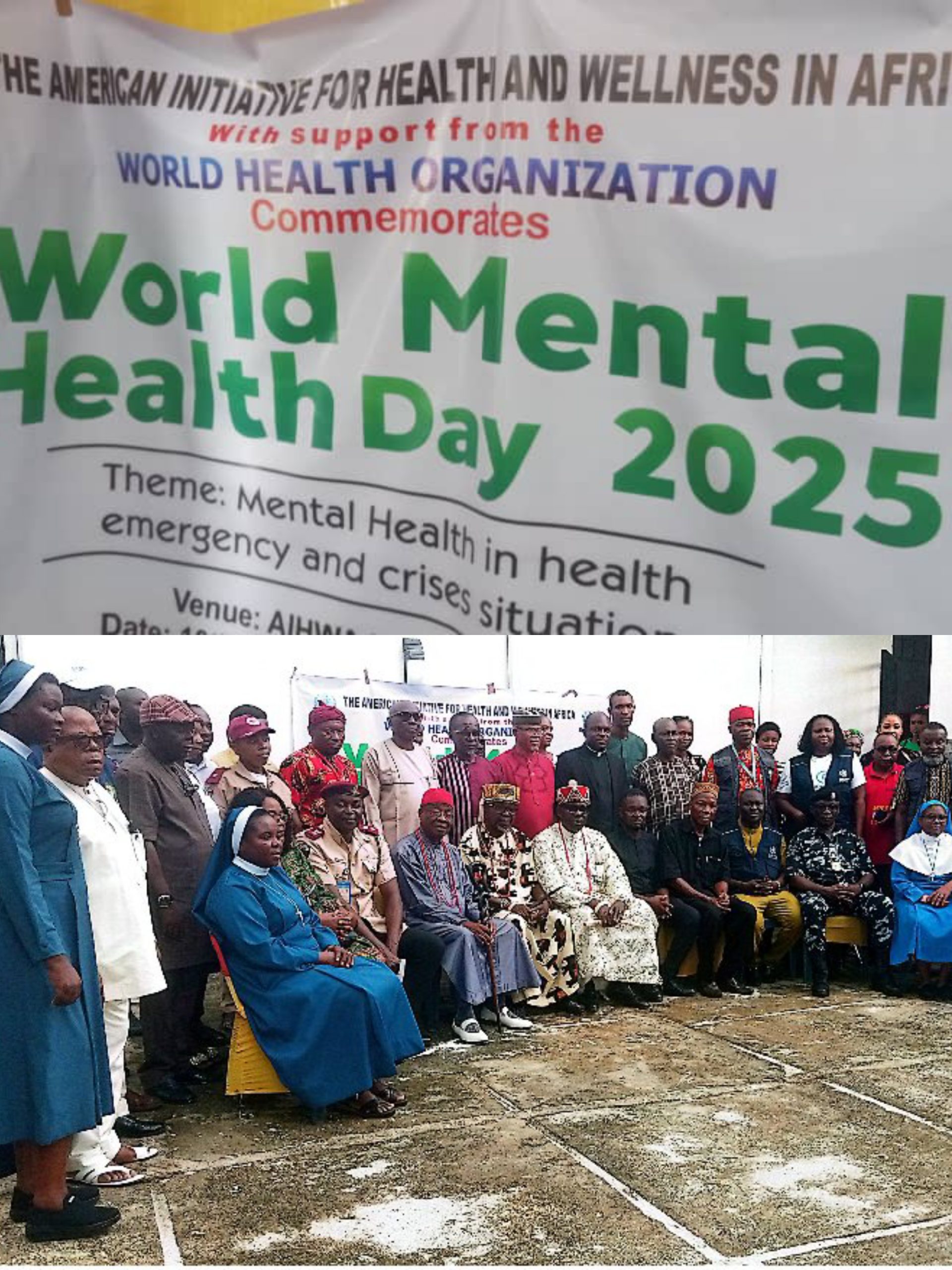
In commemoration of the 2025 World Mental Health Day, the World Health Organisation (WHO) and the American Initiative for Health and Wellness in Africa (AIHWA), on Friday, October 10, advocated an end to stigmatization and vaccine rejection that negatively affect mental health management in the country, especially in crisis situations and emergencies.
During a stakeholders engagement comprising of religious, traditional and academic institutions, as well as security agencies at the AIHWA Hope Center, Ngor-Okpala LGA, to mark the event, WHO and AIHWA also solicited support for mental health and psychosocial needs of people affected by humanitarian emergencies to reflect the 2025 theme: “Access to Services: Mental Health in Catastrophes and
Emergencies.“

In his lecture, the Imo State Surveillance Officer of WHO, Dr. Adeniyi Adeniran, representing the State Coordinator, Dr. Wadzingi Bass, noted that the theme also aimed “to strengthen mental health support systems during and after emergencies and to ensure that vulnerable populations have access to the care they need to live, to heal
and to rebuild.”
Stressing the importance of mental health,” Adeniran, said that “poor mental health significantly affects behavior, perception, thoughts, orientation, memory, judgement and insight, adding that emergency situations like natural disasters, accidents and disease outbreaks, as well as socio-political and religious crises have consequences on health, especially mental health.

Proffering solutions, the WHO staff, called for multi sectoral collaboration and action towards support for people and communities in need. He cautioned against stigma and misinformation on health interventions, and urged participants to use their positions to promote mental health awareness and vaccine confidence in their areas in order to improve mental health management.
Earlier in his keynote address, the President of AIHWA International, Rev. Fr. Dr. Kenny Udumka, CSSp, praised the collaboration between AIHWA and WHO “as a true testament of their shared commitments towards making the world a healthier place for all.”
Focusing on “Stigmatization and Mental Health Diagnostic Framework in Nigeria” Fr. Udumka, a United States certified mental health expert, raised concerns that “stigmatization and the prevailing diagnostic framework nurtured by socio-cultural, and religious perspectives in Nigeria” needed to be eliminated “to better address mental health in emergency and crisis situations.”

The Catholic priest, added that lack of awareness and enlightenment in Nigeria had “led to wrong diagnoses as well as different misguided responses towards people with mental illness and their conditions.” He attributed such to the influence of religious and cultural beliefs that encourage stigma and stigmatization, which he defined as “negative labelling of individuals or groups based on their characteristics.”
“The framework through which mental illnesses are viewed and understood affects the kind of diagnosis, attitudes towards mentally ill people, and treatment, if permissible. For instance, individuals suffering from conditions like depression or schizophrenia may be seen as possessed by evil spirits,” he said, and called for improved understanding in Nigeria.
Fr. Udumka, who advocated approach with improved medical diagnostic and treatment protocols, solicited synergy among government and relevant stakeholders in combating the stigma and ignorance associated with mental illnesses to help individuals achieve their recovery-related goals.

“This improved knowledge will not only educate about stress and genetics as possible contributing factors, but also improve proper diagnosis, reduce stigma, and encourage the need to seek help from a professional,” the priest noted.
Meanwhile, some of the participants uring interactions, admitted neglect of mental illness in the country despite it importance, while hailing the event as enlightening on the realities of mental health, including the roles of stakeholders in overcoming various bottlenecks. They also called for greater visibility of WHO and community awareness.
Some of the speakers, included: Fr. Patrick Udoaku and Fr. Jude-Thaddeus Osondu of Ahiara Diocese, the Provost, Collage of Nursing Sciences, Amaigbo, Nwangele LGA, Rev. Sr. Maria Celine Agonsi, Prof. Ndu Life Njoku of the Imo State University, Owerri, Commander, FRSC, Ngor-Okpala LGA, CRC E.O. Onofiok,
and HRH, Eze Duru Nwokeke and Eze Barnabas Obirieze among others.

