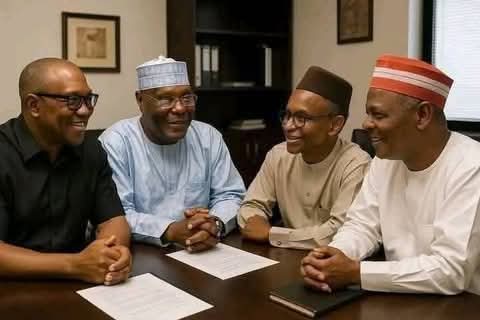
Critics question timing, blame past political rivalry for opposition’s 2023 failure
In what could mark a major shift in Nigeria’s political dynamics, former presidential candidates Peter Obi, Atiku Abubakar, and Rabiu Musa Kwankwaso are reportedly in talks to form a grand political coalition aimed at challenging President Bola Ahmed Tinubu in the 2027 general elections.
According to insiders close to the discussions, the three opposition leaders are exploring the possibility of merging their political platforms to present a united front capable of galvanizing widespread support across the country. While talks remain preliminary, the move has already stirred significant public interest and debate.
For many political observers and ordinary Nigerians, the question isn’t just whether the coalition will work—but why it took so long. In the lead-up to the 2023 elections, various calls for unity among the leading opposition candidates were ignored, as each pursued separate presidential bids under different party banners. That fragmentation, analysts argue, played directly into the hands of the ruling All Progressives Congress (APC), enabling Tinubu to secure victory despite mounting public dissatisfaction with the status quo.
This coalition should have happened three years ago,” said a prominent political analyst. “Had Obi, Atiku, and Kwankwaso set aside their personal ambitions and formed an alliance in 2023, we might be looking at a very different Nigeria today. Instead, their rivalry split the opposition and gave Tinubu a clear path to Aso Rock.
Despite the criticism, many see this renewed attempt at coalition-building as a step in the right direction—albeit delayed. Supporters argue that if the opposition begins organizing now, rather than waiting until the eve of the election, they can build a strong, grassroots-oriented movement capable of challenging the incumbent party’s dominance.
Key to the coalition’s potential success will be its ability to produce a single presidential candidate who enjoys broad acceptance across Nigeria’s diverse political and ethnic landscape. Equally important will be the development of a coherent and compelling policy agenda that addresses the country’s pressing challenges, including insecurity, economic instability, corruption, and unemployment.
The coalition will also need to demonstrate unity in action—not just in words. Many Nigerians remain skeptical, noting that previous attempts at forming political alliances have often been derailed by ego clashes, internal disagreements, and the absence of a long-term vision.
As Nigeria heads toward another critical election cycle, all eyes will be on Obi, Atiku, and Kwankwaso to see whether this alliance marks the beginning of a true opposition revival—or simply another missed opportunity in the country’s political history.
